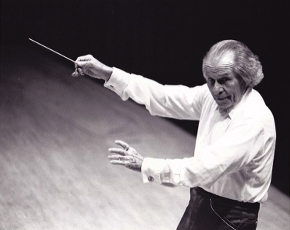
Arranger/editor Frederick Fennell (1914 – 2004) was an American conductor and one of the primary figures who promoted the Eastman Wind Ensemble as a performing group. He was also influential as a band pedagogue, and greatly affected the field of music education in the US and abroad. In Fennell’s New York Times obituary, colleague Jerry F. Junkin was quoted as saying “He was arguably the most famous band conductor since John Philip Sousa.’
Fennell was born in Cleveland, Ohio. He chose piccolo as his primary instrument at the age of seven, and later became a drummer in the fife-and-drum corps at the family's encampment called Camp Zeke. He owned his first drum set at age ten. In the John Adams High School orchestra, Fennell performed as the kettledrummer and served as the band’s drum major.
His studies at the Interlochen Arts Camp (then the National Music Camp) included being chosen by famed bandmaster Albert Austin Harding as the bass drummer in the National High School Band in 1931. The band was conducted by John Philip Sousa on July 26th of that year in a program including the premiere of Sousa's Northern Pines march. Fennell himself conducted at Interlochen at the age of seventeen.
Fennell formed a compatible and fruitful relationship with the Eastman School of Music in Rochester, New York. As a student, he organized the first University of Rochester marching band for the football team and held indoor concerts with the band after the football season for ten years. At Eastman, he completed his bachelor's and master's degrees (in 1937 and 1939). Fennell became the first person to whom the Eastman School of Music awarded a degree in percussion performance.
Fennell was one of the world’s most active and innovative maestros. He was principal guest conductor of the Dallas Wind Symphony, principal conductor of the Tokyo Kosei Wind Orchestra in Japan, and Professor Emeritus at the University of Miami School of Music. The internationally-acclaimed conductor, widely regarded as the leader of the wind ensemble movement in this country, was one of America’s most recorded American classical conductors, and was a pioneer in various methods of recording.
He also served as the conductor of the Columbia University American Festival, the National Music Camp, the Yaddo Music Period, the Eastman-Rochester Pops Orchestra and the Eastman Opera Theatre, among others.
He was principal guest conductor of the Interlochen Arts Academy, and other guest conducting stints included frequent appearances with the Boston Pops Orchestra as well as performances with the Carnegie Hall Pops Concerts and the Boston Esplanade concerts. He appeared with the Denver, San Diego, National, Hartford, St. Louis and London Symphonies; the Buffalo, Calgary and Greater Miami Philharmonic Orchestras, the Cleveland Orchestra and the New Orleans Philharmonic.
He was part of pioneering recordings with the Cleveland Symphonic Winds and Dallas Wind Symphony and he held countless honors, awards, appointments and conducting appearances.
Dr. Fennell was the conductor of the first Honor Band of America in 1992, at the debut National Concert Band Festival, held at Northwestern University.
The music for Colonel Bogey was provided for the band by Ross Fjermedal, Susan Evans and Service Dog Dewey.